|
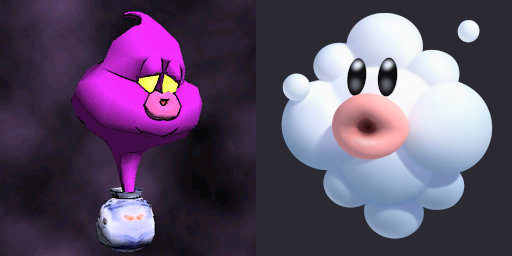
| Not that kind. |
Nintendo really loves goop.
Good old-fashioned goop, the kind that covers virtual landscapes in neon mess. Goop as gameplay is an arguably niche but time-worn mechanic at this point (Portal 2’s gel puzzles, or better yet, de Blob, innovating further by letting you be the goop) but I suspect Nintendo was largely responsible for pioneering the trend with Super Mario Sunshine.
Sunshine’s development didn’t begin, as some believe, as an extension of Super Mario 128, the sequel-that-wasn’t-a-sequel to Super Mario 64. The experiments of 128 seeded the physics approach to Super Mario Galaxy’s planetoid gravity and the herding mechanics of Pikmin (among other things), but the title that became Sunshine was going in quite a different direction under first-time lead developer Yoshiaki Koizumi. Koizumi wanted to make a game about spraying a water gun; apparently this was inspired by the trigger-like haptic feedback of the GameCube’s controller.
The entire game was born out of this germ of an idea, a solution without a problem. Why would Mario need a water gun? To clean up graffiti, of course. What kind of environment would contain lots of natural water as a design element? A tropical island. And so on. In Koizumi’s own words, as
recorded and translated by Nintendo during a 2002 interview:
When I submitted the basic proposal for the game to Mr. Miyamoto, I had already come up with the water-pistol idea. I tried to explain how the analog stick could make players feel the touch of a water pistol. Letting Mario have a water pistol alone wouldn't make the game fun. I started thinking about the best way to feature the water pistol, how Mario should move and show the water pistol. I liked the basic play control style of Super Mario 64 and thought that it should be applied to the new game. I tried to imagine what Mario would be like on the Nintendo GameCube, and, from the very beginning, I let him have a water pistol. This is where I started. […]
I asked myself what Mario should aim at with the water pistol. Opponents? A wall? Around that time, we decided to include the Wall Jump move, so we wanted to create a number of tall buildings that Mario could jump around. So, why would Mario have to move around a town with many walls? Maybe he had to clean up the town with the water pistol. I thought of the idea of painting all over the town with mud. The idea of leaving Mario's footprint on the dirt followed this original idea. In the end, I thought we could reproduce the feeling of childhood play. [...]
The water pistol game play reminded me of summer and then I came to think about a tropical island. Isn't it great to play with water on a hot island?
And so Super Mario Sunshine was created, with all of its idiosyncrasies, and deep goop gameplay entered the mainstream.
The Science of Goop
 |
| Any scientific inquiry first starts with careful observation. |
Goop as a programmed mechanic is probably not very well understood by a lot of people who aren’t programmers. I’m not a programmer, either, but I’ve managed to come to a basic understanding of the way that goop actually works within the game’s engine, thanks primarily to
this video by Angry_Max and
this excellent page on the
Super Mario Sunshine wiki.
Goop burbles up from the depths of the code via some clever modeling and mapping which cuts down on processing power and is essentially composed of four parts working together. First, let's look at the visual side. Each environment in Sunshine includes a 3D model of surfaces on which goop can possibly appear as a visual effect. This, in combination with a texture file, provides only for the appearance of goop; goop as a gameplay element can still exist outside of this visual model. This pollution model and the goop texture are two of the four ingredients that go into the production of goop.
Next, the areas in which goop -- the interactive gameplay element -- actually will be placed are determined through a binary-color bitmap, a simple 2D shape or pattern which assigns either white or black to a pixel (representing goop or nothing). This is the third part, which is then assembled with the 3D pollution model to produce goop as an interactive object in the environment. Since this entails an transfer of a 2D design onto a 3D object, there is additional "YMAP" code which assigns height to goop placement (and also handles other characteristics such as goop type), and is the last element needed to produce the goop.
The bitmap informs the visual code where to place its texture, but it should be noted that if the pollution model is misaligned with YMAP data, it is possible for goop to physically exist on a separate plane from where it visually appears. In normal gameplay, though, this never happens.
This is only part of the goop gameplay, however. The spread of goop is modifiable, both by Mario and other entities, which can either add goop to the environment or erase it with water. The water of the ocean, fountains, etc. of Sunshine is simply a 2D plane which triggers gameplay changes when a point on Mario’s model intersects with it. Water that comes out of FLUDD is a different object. When projectile water intersects with goop, it acts as an eraser, decreasing an internal goop statistic until it passes a certain threshold and vanishes. Juice from Yoshi is similarly handled but does not have all of the same mechanics as water.
To manage this functionality, the goop bitmap stored in the game's level is continuously updated in real time, changing areas from white to black or vice versa based on the movements of Mario, enemies, and projectile liquids.
Mario can interact with projectile water, which can linger on the ground momentarily before drying up; wetting the ground to perform a belly slide is an obvious example. I'm not entirely sure how this is handled by the game's code, but "wet surface" data may not be stored in the same way goop is since it is always temporary. In an interesting combination of static water and projectile water, Mario’s emergence from a body of water will cause water projectiles to fly off of him. This is not merely a visual effect, as it was in
Super Mario 64; the water that drips off of Mario has gameplay effects.
This can be used, for instance, to slowly clear a pathway to the mayor in the third level of Pianta Village via repeatedly emerging from a spring near the center of town.
It should also be noted that there are a number of things in the game that are, mechanically, goop in name only; things like the M graffiti and portals, the warp pipes and orange juice-soluble goop, and so on. These are merely individual objects and are not handled the same way internally. At least, I don’t think. I’m no goop expert.
Goop Through The Years
If there is an earlier 3D game which allowed such a dynamic goop mechanic – by which I mean the ability to “coat” or alter a 2D surface’s properties with great freedom – I haven’t found it. Probably the mechanic has its roots in drawing or painting mechanics which semi-permanently alter an in-game texture, but I am not knowledgeable enough to know when this made the jump to 3D environments if indeed there is a predecessor to Sunshine. Given comments made by Miyamoto in the same 2002 interview, it seems quite unlikely that the technical capability to produce the mechanic was even a possibility prior to the GameCube console generation:
[W]e experimented with watering and graffiti drawing and erasing, among other things. In video games, it is not a simple task to draw graffiti and have it remain there. When you remove a treasure from a treasure box, you shouldn't find the stuff in the box afterward. It's not as easy as it seems. Painting and maintaining a screen-full of graffiti is very difficult in a video game. It can be accomplished only with the GCN. Some PCs can do it, but not at such a fast speed. That is an example of one of our basic experiments.
Post-Sunshine, though, there have been plenty of games which adopt the same basic idea. As mentioned earlier, de Blob (Blue Tongue Entertainment, 2008) picks up the idea of changing the texture of the environment and runs with it. Instead of erasing pre-programmed color, however, you spread color around the world. Epic Mickey (Junction Point Studios, 2010) is another game in this vein and incorporates both a painting and erasing functionality into gameplay.
The true non-Nintendo heir to the goop throne, however, is the Portal series. There’s a case to be made for the portal mechanic of the first game (Valve, 2007) is a “goop mechanic” in all but name; the player is modifying the appearance and physical properties of a 2D surface within a 3D environment in real time. Of course, the portal is not customizable, only its placement is. But Portal 2 (Valve, 2011) unarguably acts as a spiritual successor to Sunshine with its various gel puzzles.
 |
| Blue gel bounces objects off of its surface, orange gel dramatically increases acceleration when traversed, and white gel acts as a portal-able surface wherever it's placed. Of course, water can wash any of them away. |
Inspired by elements from a previous game, Tag: The Power of Paint (notice a theme here?), the Portal 2 team hired its developers and went to town. Three gel types exist, each with their own properties. In comparison with Sunshine’s various goops, which largely just modify the form of deterrence they present (i.e. electric goop shocks Mario in place, while molten goop bounces him uncontrollably around), Portal 2’s gels actually have major gameplay integration. Sunshine keeps goop strictly as a platforming element, while Portal 2 opens up puzzle possibilities.
Portal is also notable in this vein for being one of those games in which the central mechanic determines the entirety of the rest of its design – a very Nintendo-like philosophy. Simplifying the 3D environment in order to allow limited places for the player to modify surfaces required a story narrative of a testing facility, which demanded an all-seeing presence explaining gameplay and delivering exposition, which produced an obvious source of narrative conflict, and so on.
Nintendo, for its part, has returned to the well of goop plenty of times on their own. Bowser Jr.’s turn as goop-loving villain feeds into the goop-drenched landscape of
Bowser’s Fury, though there’s not a pure “goop mechanic” in the vein of
Sunshine. Similarly,
Paper Mario: Color Splash promises a
de Blob-like ability to color the environment, but this does not allow for the kind of semi-permanent change to surfaces that
Sunshine does.
Splatoon, however, innovates on the concept by branching into another genre and using the mechanic to create a highly dynamic third-person shooter environment which allows stealth via player-spawned goop.
Developer Hisashi Nogami has stated that
Sunshine didn’t factor into the concept creation for the game, instead starting off with a piece of tofu which shot ink and could fight “turf wars” with other tofu, winning based on total surface area covered.
Again, the design of the game springs forward from goop. Once the developers realized that squids, and not living tofu, are a much more obvious choice for “thing that produces ink,” the post-mammal setting followed; the turf-war action seemed like a mildly edgy juvenile activity, so the game’s aesthetic became youth-in-the-city; and so on. If you choose goop as a mechanic, the rest of the game flows – or maybe oozes – from there.
What's interesting about goop in the long history of videogame innovation is that it represents an early form of 3D environment modification. Hardware limitations prevented fully 3D environments from being granular enough to alter, shape, or destroy to the level of detail offered by Sunshine's 2D goop, but as the 2000s wore on, this became more of a possibility. The biggest "modifiable environment" of all time is, of course, Minecraft, building on 3D trends that had been progressing for years. Nintendo began experimenting with highly granular environmental destruction in games like Super Mario Odyssey (the cheese material in the Luncheon Kingdom) and fully committed itself to this idea in Donkey Kong Bananza.
So here's to goop, primordial substance from which dozens of interesting gameplay elements have emerged. May we continue to have the opportunity to gawk at icky, paint-like substances for years to come.
SPIRIT: Isn't it interesting that when you wield goop as a good guy, the game is all about returning color to a lifeless world and when you're a bad guy, it becomes all about cleaning up other people's eyesores?